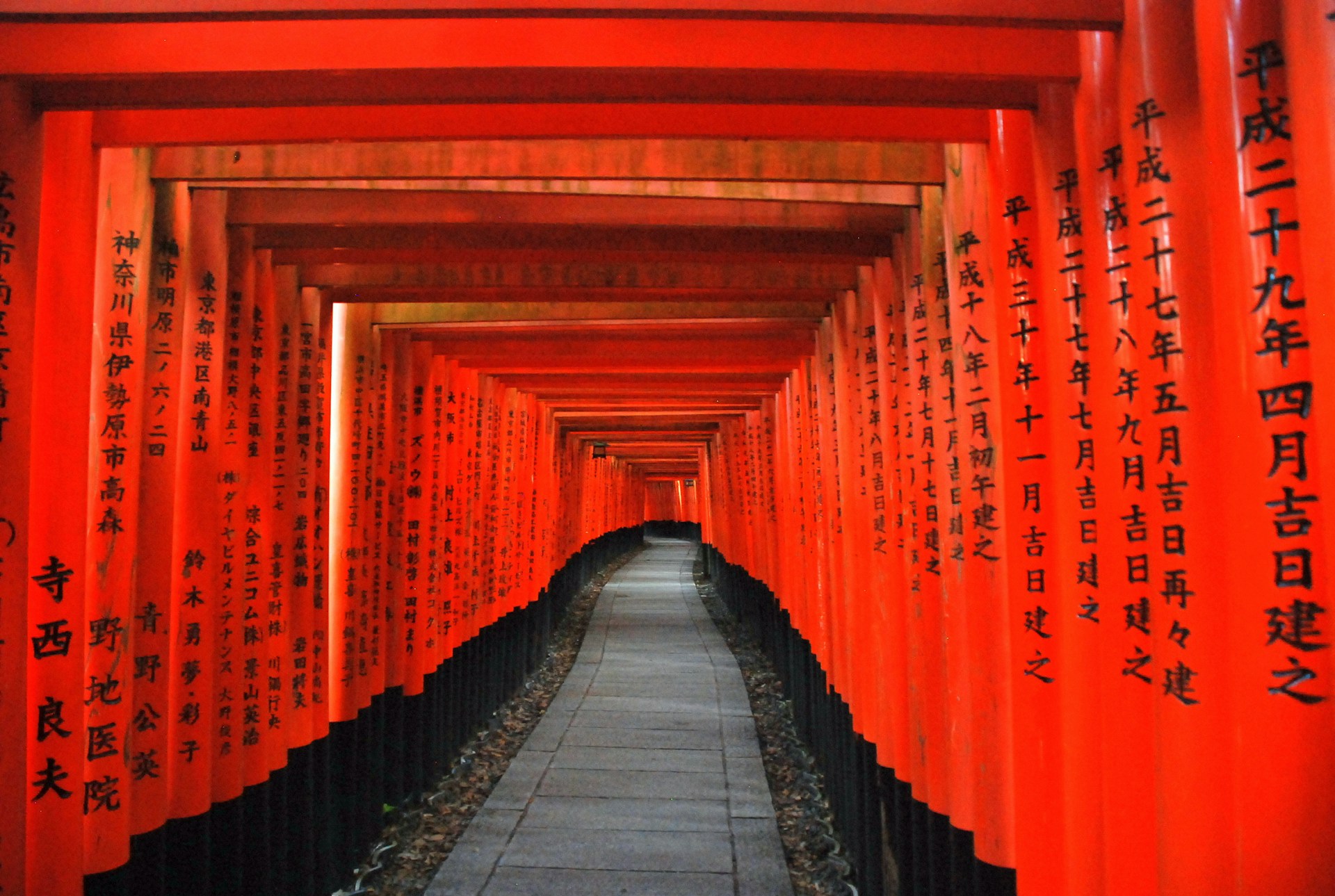
Inari Shrines are the most numerous type of shrines in Japan. There are approximately 30,000 Inari Shrines nationwide, and they exist in almost every region. The head shrine is Fushimi Inari Taisha in Kyoto, famous worldwide for its iconic sight of continuous red torii gates.
The Inari deity was originally the god of gokoku hojo (bountiful harvests of grains). However, over time, the concept shifted from “rice = money” and “harvest = prosperity.” Today, the Inari god is revered as the guardian deity of business prosperity and success. The fox (kitsune) on the shrine grounds is not the deity itself, but rather a “Divine Messenger.” They are seen as a messenger connecting humans and the gods. This is why the fox is enshrined as a sacred symbol at Inari Shrines.
Now, there is a book in Japan titled, “Why Successful People Go to Shrines.” I would like to introduce an interesting concept about Inari Shrines that is presented in this book.
For instance, suppose a person visits Inari Shrine A and privately expresses their problem to the deity. Meanwhile, another person who frequently visits Inari Shrine B happens to possess the knowledge or connection needed to solve that problem. There is a belief that an invisible force will bring these two people together (matchmaking). Inari Shrines are especially thought to be proficient at forging ties and making connections related to business and work.
It is likely that not many Japanese people view Inari Shrines as having such a concrete “network for drawing people together.” However, just as the concept of the “God of Matchmaking (Enmusubi)” is widely accepted, it is a fact that many Japanese people believe that the local deities connect people and circumstances (such as good timing or necessary information). In other words, the idea of an “invisible network of fate” that acts upon people’s wishes has been vaguely passed down among the Japanese people for hundreds of years.
Furthermore, there is the idea that “thought manifests reality.” This suggests that what you strongly think about or focus your consciousness on will come true. If many people have continued to believe for hundreds of years that “the gods will help in some way,” it would not be surprising if, in the unseen realm, a “network for forging and circulating good ties” has actually been established.
If we hypothesize that such an “invisible network of attraction” already exists, wouldn’t it be beneficial to use it? Everyone naturally puts in their own effort, but if an unseen force also lends its assistance, achieving goals would become even more effective.
Whether it is truly effective or not, and whether one chooses to believe it or not, is up to the individual. However, by visiting a shrine with the knowledge of this belief system, you might see the place not just as a tourist spot or a custom, but as “a place to attract auspicious connections and wisdom,” giving it a different meaning than before.